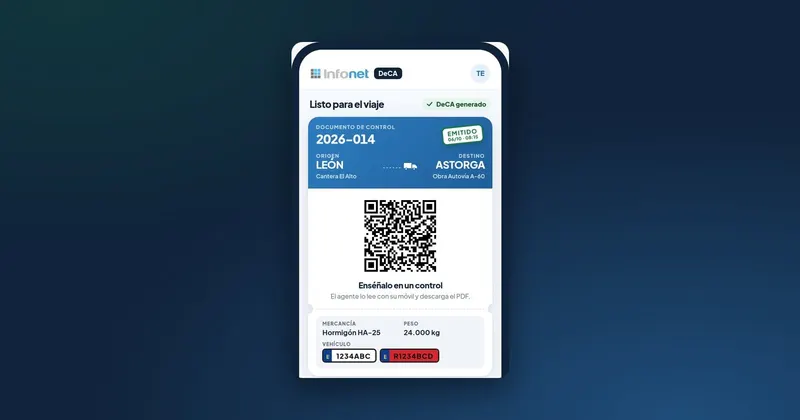
The control document has no official template: the order that regulates it says it is freely drafted and can have whatever format and name suits you best. What is mandatory is its content. If an essential item is missing, the document is non-compliant, even if it has a perfect QR code. Here is the full list, who is responsible for each item and how to handle the cases where the information is not obvious.
The essential data in article 6
Article 6 of Orden FOM/2861/2012 (the Spanish ministerial order governing the control document for road freight transport) lists the data the document must contain "at least". Article 7, as worded by Orden TRM/282/2026 (the Spanish ministerial order that amended it), allocates responsibility for each item:
| Letter | Item | Responsible party |
|---|---|---|
| a) | Name or company name, NIF (Spanish tax ID) and address of the contractual shipper | Contractual shipper |
| b) | Name or company name and NIF of the actual carrier | Contractual shipper |
| c) | Place of origin and destination of the consignment | Contractual shipper |
| d) | Nature and weight of the goods | Contractual shipper |
| e) | Identification of the special movement permit, when the vehicle travels under one | Actual carrier |
| f) | Date on which the transport is carried out | Actual carrier |
| g) | Vehicle registration number; for an articulated combination, that of the tractor unit and of the trailer or semi-trailer | Actual carrier |
| h) | Remarks, reservations or instructions requested by the parties involved | Whoever includes them |
Items a) to d) are the contractual shipper's responsibility and items e) to g) the actual carrier's. This matters when there is a mistake: whoever issues the document is not responsible for everything, only for their own part.
How to fill in each item without errors
Contractual shipper and actual carrier
The contractual shipper is whoever contracts the transport directly with the party that carries it out. They are not always the owner of the goods: they may be a cooperative, a warehouse operator, a logistics operator, an agency or a carrier that subcontracts. The actual carrier is the holder of the authorisation under which the transport is physically carried out. If the journey is made by a subcontracted self-employed driver, the actual carrier is that driver, not the company that passed the job on to them.
The Resolution of 5 June 2026 (published in the BOE, Spain's official gazette) insists that, whatever format you use, the two parties must be identified "expressly and separately". It is not enough for two companies to appear in the document: it must be clear which is which.
Origin and destination
The place where that consignment is loaded and where it is unloaded. This means an address or an identifiable place (a quarry, a building site with its location, a warehouse). If there are several unloading points, each consignment must have its own.
Nature and weight
What is being carried and how much it weighs. The order provides that, when it is hard to know the exact weight before loading, another measure may be used. The Ministry's FAQs give examples such as milk collection, agricultural products, live animals, earthmoving or the supply of aggregates and concrete. In those cases you can state the activity ("supply of ready-mixed concrete") and a reasonable alternative measure, such as volume, units or head of livestock. If practically the vehicle's full capacity is going to be used, the Ministry accepts stating the vehicle's MAM (maximum authorised mass).
Special movement permit
Only when the vehicle travels under a special traffic permit, for example in some transports because of their dimensions or mass. If there is none, leave it blank.
Date
The date on which the transport of that consignment takes place. It should not be confused with the PDF creation date, which goes in its metadata and must be earlier than the start of the service.
Registration numbers
That of the vehicle and, for an articulated combination, also that of the trailer or semi-trailer. This is one of the easiest mistakes to make: the tractor unit is known in advance, but the semi-trailer is coupled at the last moment. If the vehicle changes once the transport has started, the order requires this to be recorded in the document.
Remarks
These are optional: reservations about the condition of the load, instructions, internal references. They are only included if the parties involved ask for it, and whoever adds them is responsible for them.
What is not mandatory
The control document does not require the price of the transport, the consignee of the goods, the number of packages or the signature of the parties. Those are items proper to the consignment note. You can add them if your document performs both functions, but their absence does not invalidate the control document. What you must avoid is burying the essential items or leaving them unlabelled because you have crammed in too much data.
File requirements, in addition to the data
From 05/10/2026, having the right data is not enough: the document must comply with the resolution. In summary:
- A PDF of 5 MB at most, natively digitally generated (not scanned), with the creation and modification date and time in the metadata.
- Created before the actual start of the service.
- Stored in a repository, with a single https URL that downloads the PDF directly, with no credentials or buttons.
- With a QR code inside the PDF itself containing that URL.
- Kept for at least one year.
Checklist before the lorry leaves
- Do the contractual shipper and the actual carrier appear labelled separately, with their NIFs?
- Is the contractual shipper's address included?
- Is there an origin and a destination for each consignment?
- Are there nature and weight, or a justified alternative measure?
- Is the trailer or semi-trailer registration number there, as well as the tractor unit's?
- Is the transport date correct?
- Does the PDF carry the QR code, and was it created before departure?
- Does the driver already have it, on their phone or printed?
How DeCA handles it
DeCA validates every item in article 6 before generating the document, and in the PDF the shipper and the carrier are labelled and kept separate. If you do it from the web, you fill in the form with help from what you have used before (shippers, carriers, registration numbers), and if you upload the PDF from your own software, DeCA reads its data so you do not have to type it in.
If you contract transport, DeCA for shippers explains which data you provide. In DeCA for concrete plants you will find the case of the supply delivery note and the alternative to weight.