Now that the control document has to be electronic, many shippers assume it is the haulier's job, while many hauliers assume the customer has to provide it. The regulation does not settle who physically produces it, but it does settle who is obliged to and who is liable. Understanding those two roles, the contractual shipper and the actual haulier, is what lets you split the work properly and avoid turning up at the warehouse gate without a document.
The two parties obliged
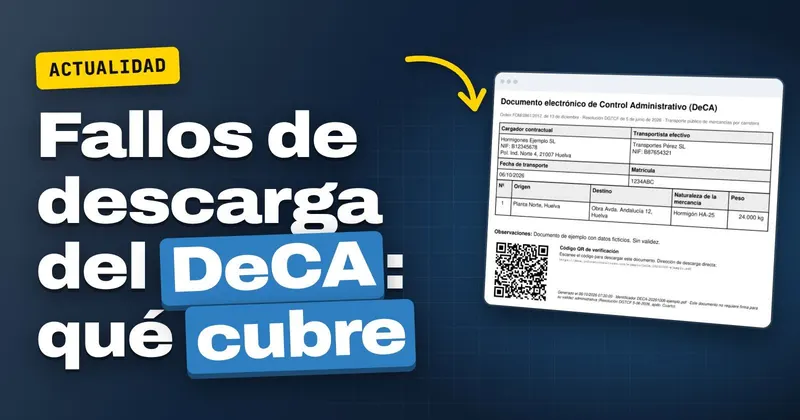
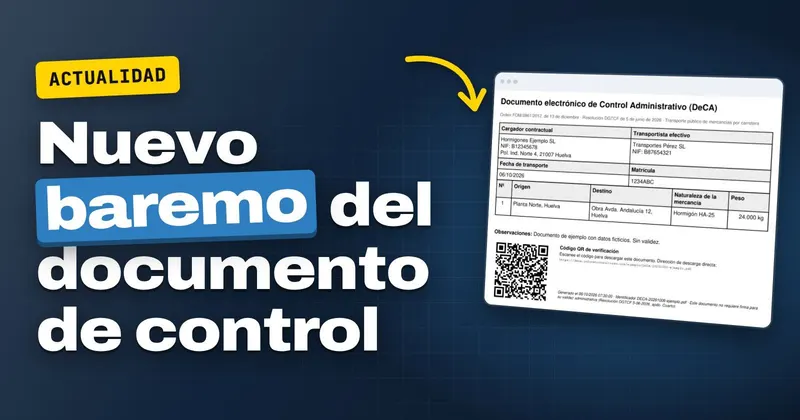
Article 4 of Orden FOM/2861/2012 (the Spanish ministerial order regulating the electronic control document for road freight) requires two parties to complete the document:
- Actual haulier: the holder of the authorisation under which the transport is physically carried out. This is the party moving the goods with its own lorry.
- Contractual shipper: the party that contracts directly with the actual haulier for the transport of the consignment. The order lists examples: the actual shipper itself, another haulier, a cooperative or marketing company, a transport agency, a freight forwarder, a warehouse-distributor, a logistics operator or anyone who habitually contracts transport or acts as an intermediary in contracting it.
The contractual shipper does not have to be the owner of the goods or the party selling them. It is the party that signs the order with the haulier making the journey.
What the regulation says about who generates it
The Ministry of Transport's FAQs answer this question directly: the order does not specify who must physically produce the document, but it establishes that both parties are obliged to complete it. Digitalisation has not changed that split.
So you are free to organise it as you wish. It can be generated by the shipper, by the haulier or by a third party working for either of them. What you cannot have is nobody doing it because each thought the other was.
Who is liable for what
Article 7 of the order, amended in 2026 by Orden TRM/282/2026, allocates liability:
| Situation | Liable party |
|---|---|
| The document is not completed | Contractual shipper and actual haulier |
| It is not carried on board | Both, unless the shipper proves it issued the document |
| Details of the parties, origin and destination, goods (points (a) to (d) of art. 6) | Contractual shipper |
| Special authorisation, date and registration plates (points (e) to (g)) | Actual haulier |
| Remarks (point (h)) | Whoever includes them |
Two practical ideas follow from this. First: the shipper knows half of the data best (who the parties are, where the goods are going, what is being loaded and how much it weighs) and the haulier knows the other half (which lorry, which trailer, which day). Second: a shipper that issues the document and can prove it is exempt if the lorry then fails to carry it.
Common scenarios
You sell delivered to destination and hire the lorry
You are the contractual shipper. This is the typical case of a plant, a quarry or a warehouse that hires self-employed drivers to take goods to the customer.
The customer collects with a lorry they have hired themselves
The contractual shipper is your customer, because they are the one contracting the transport. Even so, nothing prevents you from generating the document with the data from your weighbridge or your delivery note if you agree to it: you know the weight and the goods better than anyone.
A haulier subcontracts the journey
The Ministry explains it with an example: if haulier A subcontracts haulier B for a consignment, B is the actual haulier and A is the contractual shipper. Liability falls on the party that physically carries out the transport, the last in the chain, and on the party that contracts it. A's original customer does not appear as the contractual shipper in the document for that consignment.
Logistics operator or agency
If you hire an operator and it hires the lorry, the operator is the contractual shipper in relation to that haulier. If the operator has its own lorries and makes the journey itself, you are the contractual shipper and the operator is the actual haulier.
Retention: one copy for each party
Article 8 of the order refers to two copies, one for each party, and article 9 requires the document to be kept for at least one year. The Resolución de 5 de junio de 2026 (the resolution of 5 June 2026) adapts this to the electronic format: shipper and haulier must keep the file for at least one year, each may have its own repository and, if one of them generated it, it is enough that the other can download it during that year.
How to organise it without disputes
- Agree it in writing, in the contract or in an email with each regular haulier: who generates the document and by what means it is handed to the driver.
- Split the data. If the shipper generates it, it needs to know the registration plate of the tractor unit and the trailer before departure. If the haulier generates it, it needs the origin, destination, goods and weight from the shipper.
- Decide who makes corrections. A change of trailer is known first to the haulier; a change of destination, to the shipper.
- Make sure you can both download it for one year.
- Do not duplicate. Two different documents for the same consignment, with data that does not match, are a source of problems at a roadside check.
How DeCA solves it
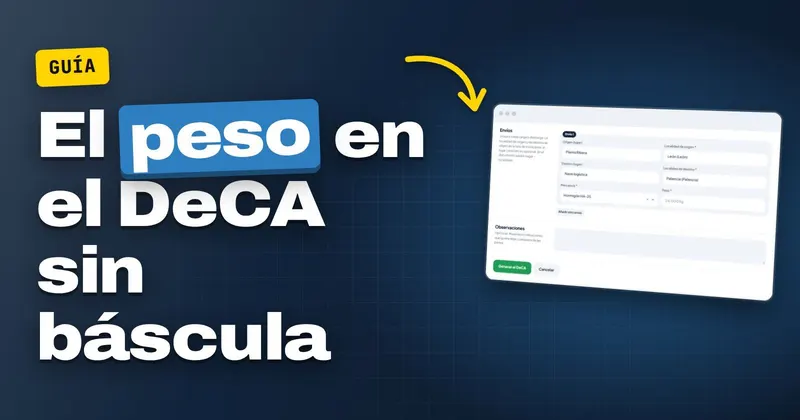
Many companies that hire transport prefer to issue the document themselves: the data comes from their delivery note and it is recorded with the date and time it was generated. With DeCA you do it from your software or from the web, and the haulier does not have to register or install anything: they receive the PDF with the QR code by WhatsApp or on a printed ticket. If something changes en route, a new version is generated with the reason and the previous one is kept.
If you hire lorries, you will find the details in DeCA for shippers. If you are a haulier who passes on journeys, see DeCA for hauliers who subcontract. And if you are a cooperative that contracts the transport of its produce, see DeCA for agricultural cooperatives.