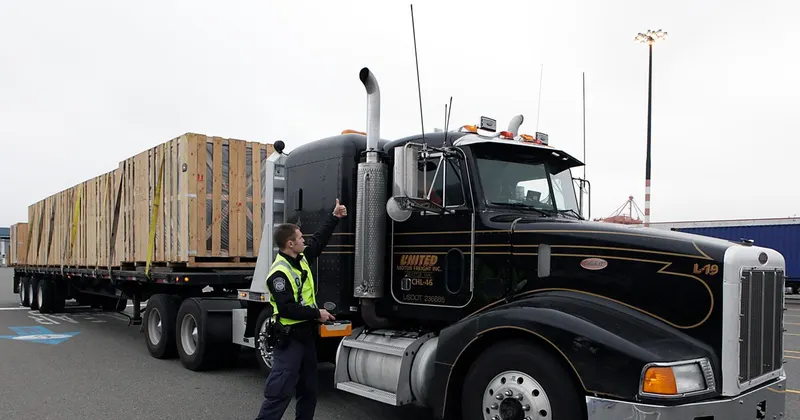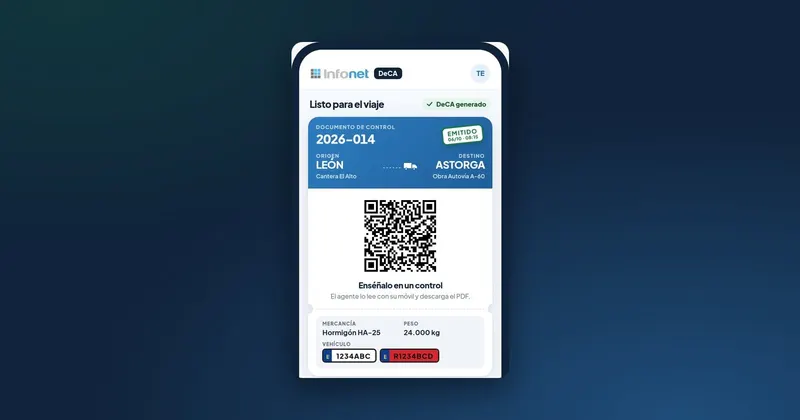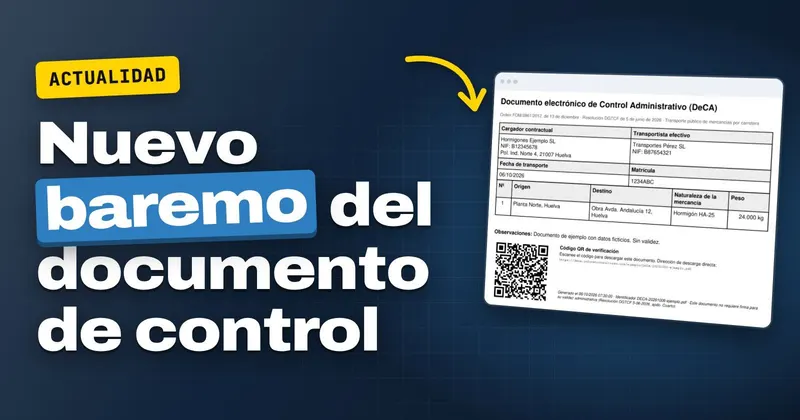
Your tanker leaves your plant with a self-employed driver at the wheel and, halfway along the route, at a roadside check, the QR code won't open. Since version 7.4 of the penalty scale, inspectors have a specific code for every failure of the transport control document. The obligations are the same ones already set by the Order and the 2026 Resolution. Below you will find the four infringements the scale lists, which ones apply to you as the contractual shipper, and four checks to carry out before each lorry leaves.
What changes in the transport control document with penalty scale 7.4
As reported by Diario del Transporte on 22/10/2026, the Subdirección General de Inspección de Transporte por Carretera (the Spanish road transport inspection authority) has published version 7.4 of the penalty scale, with the regulations updated to 05/10/2026. That is the date on which the control document became digital-only, under Ley 9/2025, eighth transitional provision (Spanish Act 9/2025).
The new codes cover four situations:
- not having the DeCA;
- not keeping it for one year;
- not showing the essential details of the service;
- not giving the driver a copy that can be required at the roadside.
All four obligations stem from Orden FOM/2861/2012 (the Spanish ministerial order regulating the control document) (BOE, Spain's Official State Gazette, of 05/01/2013) and from the Resolución de la DGTCF of 05/06/2026 (the resolution of the Spanish Directorate-General for Land Transport) (BOE of 12/06/2026). With the penalty scale, every failure now has its own box on the inspection form, which leaves little room for interpretation.
Which infringements apply to you as the contractual shipper
Of the four, three affect the contractual shipper directly: issuing the document, keeping it for a year and making sure it carries the essential details. The copy on board is carried by the driver, although the company must make sure the driver has it.
| Penalty scale infringement | What the regulation requires | Who is liable |
|---|---|---|
| Not having the DeCA | Draw up the document and carry it on board (Order, art. 7.1) | Both. The shipper is exempt if it can prove the document was issued |
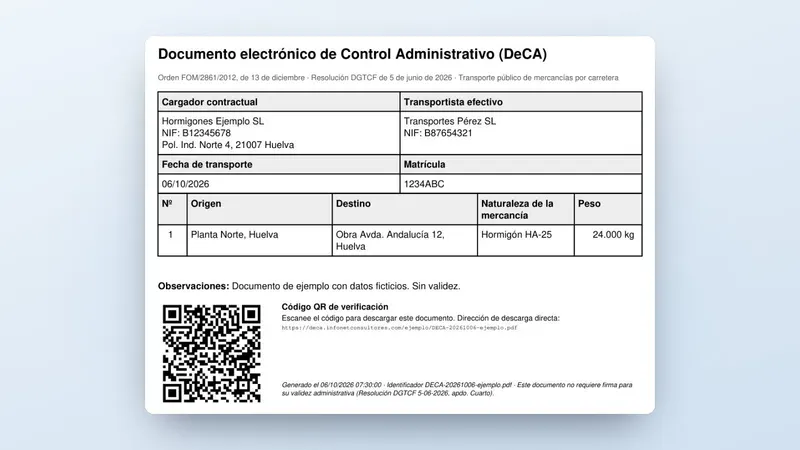
| Essential details | The details in art. 6 of the Order | Shipper: a) to d), that is, its own details, those of the actual carrier, origin and destination, and nature and weight of the goods. Carrier: e) to g), special authorisation, date and registration number (Orden TRM/282/2026) |
| Retention | One copy or duplicate for at least one year, in any format (Order, art. 9) | Directly affects you as the shipper |
| Copy for the driver | Copy before the service, on a mobile phone or printed (Resolution of 05/06/2026) | The driver carries it; the company makes sure the driver has it (LOTT, art. 141.17) |
If you want to go through the eight details one by one, along with the tricky cases such as concrete measured in cubic metres, see what details the control document must include.
How much the fine is and how it is counted
The penalty scale organises the offences; the amounts are set by the LOTT (the Spanish Road Transport Management Act). Failing to have the control document, or its essential details, is a serious infringement under art. 141.17, with a fine of €401 to €600 (art. 143.1.d). Each shipment is counted separately: art. 138.3 treats infringements committed on different consignments as independent.
The Ministerio de Transportes (Spain's Ministry of Transport) states in its DeCA frequently asked questions that no penalty-free phase is planned beyond 05/10/2026. For you, as the shipper, art. 7.1 matters most: if you prove that you issued the document, you are exempt. The full split of liability between shipper and carrier is covered in fines for not carrying the control document.
That proof depends on every DeCA being generated from your delivery note with your four details and stored with its creation date and time. If you want to see how DeCA does this for the shipments from your plant, quarry or warehouse, leave us your details and we will call you.
Four checks before the lorry leaves
1. The DeCA is issued before departure
A natively generated digital PDF must exist, of 5 MB at most, with the QR code inside and an https URL for direct download. A photo of the delivery note or a scan does not meet the Resolution. The typical mistakes at this stage are covered in common mistakes when filling in the control document.
2. Your four details are complete
Name, tax ID (NIF) and address of the contractual shipper; name and NIF of the actual carrier; origin and destination; nature and weight of the goods. If the weight is hard to determine, the Order allows another unit of measure. These are the details that come out best from your own delivery note or weighbridge ticket.
3. The driver carries their copy with a QR code that opens
A mobile phone or paper both work. What matters is that the inspector can scan the QR code and download the document. To prepare your staff and self-employed drivers, see how to train drivers on the control document.
If something changes en route, it is corrected with a new version of the document or in the same PDF stating the reason. According to the Resolution of 05/06/2026, handwritten notes on the paper copy are not taken into account.
4. You keep it for at least a year
The URL can be deactivated seven calendar days after the end of the service, but the document must be kept for at least a year. Decide today where each DeCA is stored and who will find it if you are asked for it.
How DeCA covers these four checks
In DeCA the document comes from the delivery note you already produce: from Gesthorm, Arigest, CargoGest or Agrocom, or from your own software via the API. Every item of data is validated before generation, and the shipper and carrier are labelled and kept separate in the PDF. It weighs about 12 KB and carries the creation and modification date and time.
The copy reaches the driver with one click on WhatsApp, with the number and link ready to send, or printed on the ticket with the QR code. The carrier does not need to register or install anything.
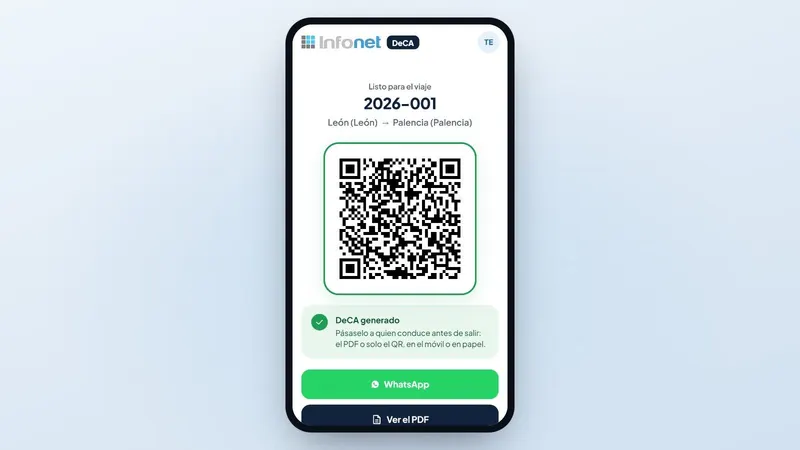
If something changes en route, a new version is generated with the reason and the previous one is kept; no document is ever deleted from the repository. The fee is €25 per month + VAT per company, with unlimited documents and users and no minimum contract.
What to do this week with your traffic manager
- Take the DeCAs for the lorries that left yesterday and run the four checks on them: issued, your details complete, copy on board with QR code, and stored.
- Ask two regular carriers how they receive the document and whether the QR code opens the PDF on their phone.
- See on the DeCA page for shippers how it fits with the way you work and, if you want the DeCA to come from your delivery note without typing twice, leave us your details and we will call you to go through it with your own shipments.